
By Lelo Klaas
Do you want me to tell you the difference between SEO and GEO, or do you want to guess first?
Actually, it’s alright. We’re already here, so let me tell you. I’m itching to share this one because the more I explore Generative Engine Optimisation, the more I realise that this is not really an SEO-versus-GEO conversation. It is a conversation about how search is changing, how our behaviour is changing with it, and how those of us working in digital need to change the way we think about being found online.
If you have worked anywhere near digital marketing, you probably already know SEO. Search Engine Optimisation has been part of our language for years. We optimise websites and content so that search engines can understand them and, hopefully, show them to the right person when they search.
Then along comes GEO, or Generative Engine Optimisation, and naturally the first reaction is: Oh great, another acronym.
I had the same thought.
But GEO started making much more sense to me when I stopped looking at it as another marketing term and started looking at my own behaviour online.
Think about how you search now
When I want to know something, I do not necessarily search the way I did a few years ago.
There are still times when I go to Google, type in a few words, scan the results and open a website. That behaviour has not disappeared.
But there are also times when I simply ask AI.
And I do not speak to AI in keywords.
I ask questions.
I explain what I am trying to do. I add context. I ask a follow-up question. If the answer does not quite make sense, I ask again. If I want a comparison, I ask for one. If I want the information simplified, I say so.
That is the difference that made GEO click for me.
Traditional search often begins with a query and gives us a selection of results to explore. Generative search can take the question, interpret the context and attempt to give us an answer there and then.
That changes the job of optimisation.
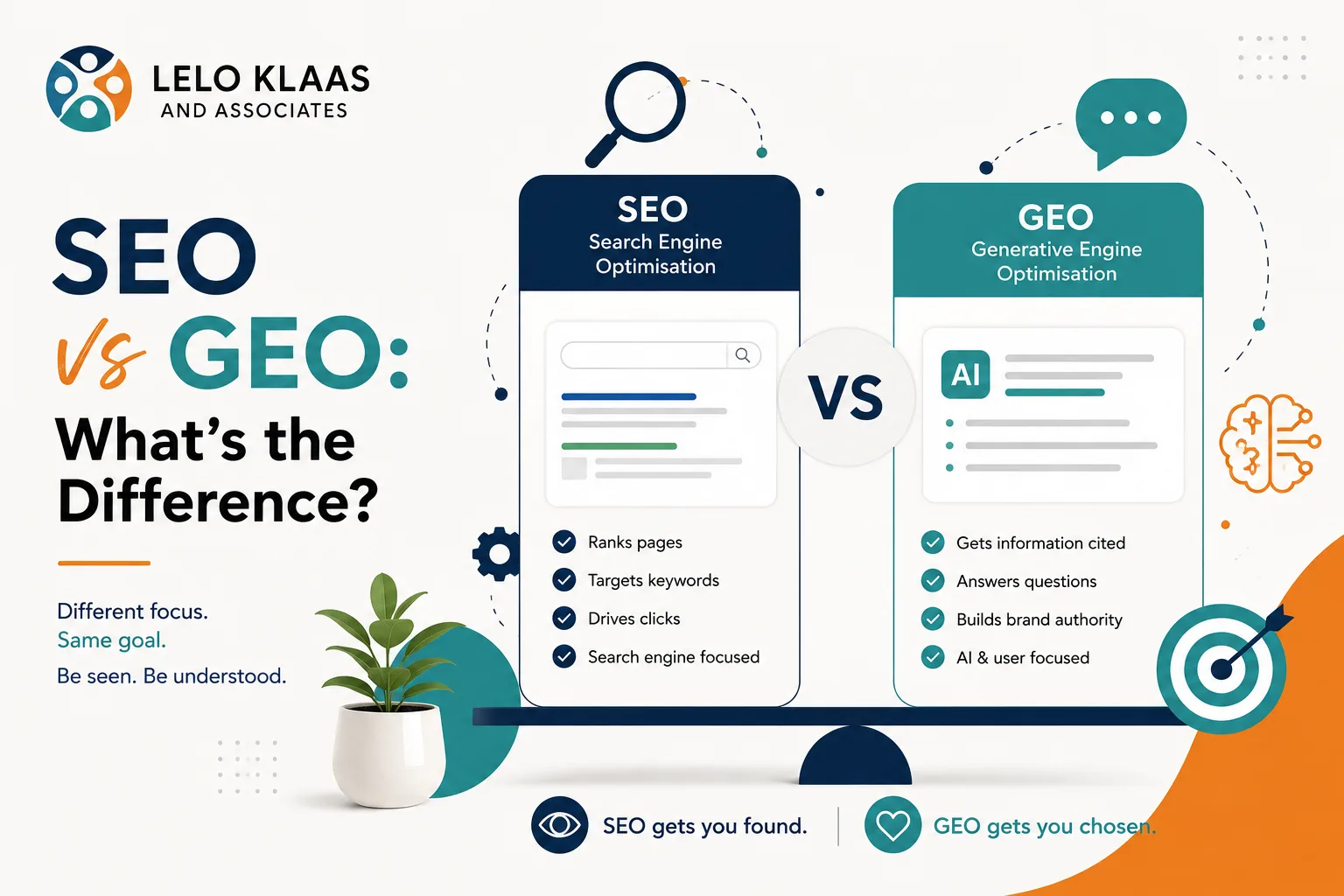
SEO wants you to be found. GEO wants you to be understood.
I think this is probably the simplest way I can explain the difference.
With SEO, we are trying to improve the chances of our pages being discovered through search engines. We think about technical performance, keywords, search intent, content quality, internal linking, backlinks, structured information and many other signals that can help search engines understand and rank a page.
GEO looks at another part of the discovery journey. It asks how we make our information clear, useful, credible and understandable enough that generative AI systems can recognise its relevance when producing answers.
In other words, SEO might help someone find your page.
GEO is increasingly about helping AI understand what you know.
Those two things are not enemies. In fact, they have quite a lot in common.
So, is GEO replacing SEO?
No. At least, that is not how I see it.
I think we need to be careful whenever a new technology arrives and suddenly everything that came before it is declared dead.
SEO is not dead.
Google is not disappearing tomorrow.
Websites are not becoming irrelevant.
People are still searching, browsing, comparing and clicking.
What is changing is that we now have more ways to discover information.
That means I would rather think about SEO and GEO as two parts of a much bigger visibility strategy.
SEO asks: Can the search engine find, understand and rank my content?
GEO adds another question: Can a generative engine understand my information well enough to use it when answering a relevant question?
For brands, both questions matter.
The difference becomes clearer when you think about the result
Imagine you run a business selling skincare products.
Someone goes to Google and searches for “best moisturiser for dry sensitive skin”.
With SEO, your goal may be to have your category page, product page, buying guide or article appear prominently in those search results. You want the customer to see your listing, click through to your website and continue their journey.
Now imagine that same person asks an AI assistant: “My skin becomes very dry in winter but it is also sensitive. What ingredients should I look for in a moisturiser?”
The customer may receive an answer without immediately visiting ten different websites.
That creates a different challenge for brands.
If an AI system is constructing that answer, where is it getting its information? Which sources does it trust? Which brands does it recognise? Which experts does it reference? Which websites explain the subject clearly enough to contribute useful information?
That is the territory GEO is trying to understand.
We need to stop thinking only about keywords
Keywords still matter because language matters. Search intent still matters. Understanding what customers are looking for will continue to be fundamental to digital marketing.
But AI is making context much harder to ignore.
People can now search with complete thoughts.
Instead of typing “running shoes women”, someone might ask, “I have just started running three times a week, mostly on the road, and I need comfortable shoes that will not feel too heavy. What should I look for?”
Look at how much information is inside that question.
The person is a beginner. They run regularly. They mainly run on roads. Comfort matters. Weight matters. They are probably still researching rather than looking for one specific product.
That is incredibly valuable context.
It means content strategies need to move beyond asking, “Which keyword are we targeting?”
We should also be asking, “What is the person actually trying to understand?”
That is a much more human question.
Funny enough, AI may force us to write for humans again
This is one of my favourite parts of this whole shift.
For years, we have been told to write for people, not search engines, but we all know there have been moments when digital content has looked suspiciously like it was written for an algorithm.
We have all seen those articles.
A simple question somehow requires 2,500 words, the same keyword appears everywhere, and you are halfway through the page before anyone actually answers what you searched for.
AI changes the economics of average content because producing generic information is becoming incredibly easy.
If anyone can create 100 average articles, then having 100 average articles is no longer much of an advantage.
What becomes more valuable is having something worth saying.
Original experience matters.
Expertise matters.
Research matters.
First-hand knowledge matters.
Clear explanations matter.
Accurate product information matters.
Trust matters.
Your brand’s unique knowledge matters.
That is why I think GEO could eventually push businesses to look much more carefully at the information they already have.
Your best GEO ideas may already be sitting inside your business
Think about how much customer knowledge exists inside an organisation.
Your customer-service team knows what people repeatedly struggle with. Your website search data tells you what customers are trying to find. Your reviews tell you what people love and what frustrates them. Your product teams understand details that might never make it onto a product page. Your analytics show where customers leave. Your sales teams hear objections and questions every day.
That information is gold.
The opportunity is to take those insights and turn them into genuinely useful digital experiences and content.
Instead of creating another article simply because a keyword tool says there is search volume, we can start with the customer problem.
What are people confused about?
What are they comparing?
What questions keep coming up?
What information would make their decision easier?
What do we know that could genuinely help them?
Answer those questions well and suddenly SEO, GEO, content strategy and customer experience begin working together rather than sitting in separate boxes.
GEO also changes how I think about success
SEO has given us a familiar collection of metrics over the years. We look at rankings, impressions, clicks, organic sessions, conversions, click-through rates and revenue.
Generative search complicates that picture.
What happens when someone discovers your brand through an AI-generated answer?
What happens when your information contributes to an answer but the person does not immediately click?
What happens when AI mentions your brand while someone is comparing options?
What happens when a customer first learns about you through AI and only searches for your brand later?
Those journeys are going to make attribution interesting.
Very interesting.
It means our measurement frameworks will have to evolve alongside the technology. Visibility may no longer mean only appearing on page one. It could also mean being mentioned, cited, recommended or represented accurately within an AI-generated experience.
We are still learning how best to measure all of this, which is exactly why I think this is such an interesting time to be working in search.
SEO and GEO need each other more than we think
The more I learn about GEO, the less I want to put SEO and GEO into opposite corners.
A strong website still matters.
Good technical foundations still matter.
Clear site architecture matters.
Useful content matters.
Authority matters.
Trust matters.
Structured information matters.
Understanding customer intent matters.
Those principles do not suddenly disappear because somebody is asking an AI assistant instead of typing a query into Google.
What changes is the destination.
Sometimes we are optimising for a search results page. Increasingly, we may also be optimising for an answer.
That is why I see GEO as an extension of the work many of us are already doing rather than something that requires us to throw everything away and start again.
And this is where AI gets exciting for me
I do not want AI to become something that is simply there.
I do not want businesses to say, “Yes, we use AI,” simply because somebody bought a licence for an AI tool.
I want us to ask what we can actually do with it.
Can we understand our customers better?
Can we analyse search behaviour differently?
Can we identify gaps in our content?
Can we connect information that previously sat in different departments?
Can we make discovery easier?
Can we answer questions better?
Can we save time on repetitive work and spend more time thinking strategically?
That is the part I am increasingly excited about.
Because access to AI will not necessarily be the competitive advantage. Eventually, almost everyone will have access to similar technology.
Knowing what to do with it is where the difference will be.
So, SEO or GEO?
If you have made it this far hoping I would choose one, I am going to disappoint you.
I choose both.
SEO helps us remain visible in the search ecosystem we already know. GEO prepares us for a discovery environment that is becoming more conversational, more contextual and increasingly influenced by generative AI.
I do not believe businesses should panic and suddenly rename their SEO teams GEO teams.
I do believe we should start learning.
Experiment with AI search. Ask questions about your own brand. See what comes back. Look at how your products, services and areas of expertise are described. Pay attention to which sources appear. Think about the questions your customers might ask differently when they are talking to an AI assistant rather than typing into a traditional search box.
Be curious.
Because the real difference between SEO and GEO is not simply one acronym replacing another.
It is a sign that the way people find information is evolving.
SEO taught us how to compete for the click.
GEO is teaching us to think about how we become part of the answer.
And personally, I cannot wait to see where that takes us.