
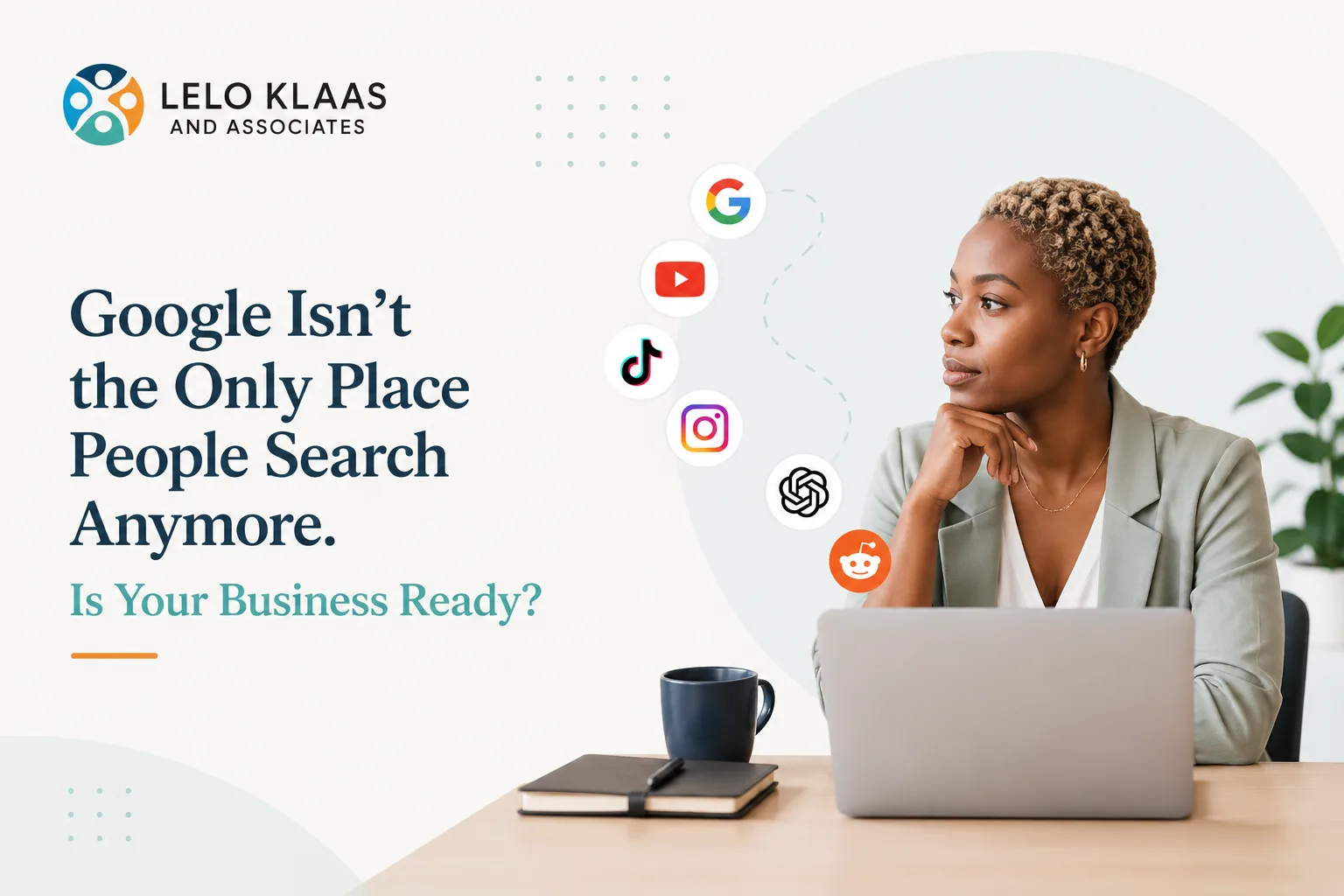
For years, businesses were given fairly straightforward advice about being found online. Build a website, optimise it for Google, choose the right keywords, publish useful content, work on your rankings and try to get onto the first page of search results.
That advice is not suddenly useless. Google still matters enormously. Search engine optimisation still matters. Your website still matters. But the way people find information, products, services and businesses is changing, and businesses that continue treating Google as the entire search strategy are going to miss a very important shift.
People are searching everywhere now.
They search Google, but they also search TikTok for recommendations, YouTube for explanations, Instagram for businesses, marketplaces for products, Reddit for opinions and increasingly AI tools such as ChatGPT and Gemini for direct answers.
The uncomfortable part for businesses is that customers do not particularly care what we call any of this. They are not sitting at home wondering whether they are performing a traditional search, a social search or an AI-assisted discovery journey. They simply have a question and they want an answer.
The real question for your business is whether you appear when they go looking for it.
Search Has Escaped the Search Bar
For a long time, we associated search with a very specific behaviour. Someone opened Google, typed a few words into a search box and received a page filled with links.
That behaviour still exists, but it is no longer the only game in town.
Someone looking for a restaurant might search TikTok because they want to see the food and atmosphere before booking. Someone trying to fix something might go directly to YouTube. Someone researching a product might search Reddit because they want opinions from actual users rather than another beautifully written brand description.
Then there is AI.
A potential customer can now ask an AI assistant something far more detailed than the short keyword searches businesses traditionally optimised for. Instead of searching for “SEO company Cape Town”, someone can ask a much more natural question such as, “What should I look for when choosing an SEO agency for a small South African ecommerce business?”
That is a completely different search experience.
The customer is no longer necessarily asking for ten blue links. They are asking for an answer.
And that changes the challenge for businesses.
Ranking Is No Longer the Only Question
Businesses have spent years asking one question: Where do we rank?
It is still an important question, but it is becoming insufficient.
We also need to start asking whether our businesses can be understood.
Can a search engine clearly determine what your company does? Can an AI system understand your services, expertise and areas of operation? Can someone find useful information about your business outside your own website? Does your content answer genuine customer questions? Is your brand mentioned by credible external sources? Is your business information consistent across the internet?
Most importantly, when someone asks a question related to the problem your business solves, are you part of the digital information available to answer that question?
That is a much bigger conversation than inserting keywords into a webpage.
Your Website Still Matters, Possibly More Than You Think
Whenever technology changes, we have a terrible habit of declaring whatever came before it dead.
SEO is dead. Websites are dead. Google is dead. Social media is dead. Email is dead.
Apparently, everything in digital marketing has died at least seventeen times.
Your website is not dead.
In fact, as search becomes more fragmented, having a clear, authoritative and well-structured source of information about your business becomes incredibly important.
The problem is that many business websites contain surprisingly little useful information.
There is a homepage saying the company is “passionate about delivering innovative solutions”. There is an About Us page containing another paragraph about excellence. There are three service pages with approximately 100 words each, and then everybody wonders why search engines and AI systems do not seem to understand the business.
Understand what, exactly?
You haven’t told them anything.
If your website does not clearly explain what you do, who you help, where you operate, what problems you solve and why your expertise should be trusted, you cannot expect technology to magically fill in the gaps.
AI Search Makes Weak Content Painfully Obvious
Traditional SEO created some bad habits.
Businesses learned that certain keywords had search volume, so everybody started producing content around those keywords. The internet became flooded with articles written primarily to attract search traffic rather than genuinely answer questions.
We have all seen them.
You search for a simple answer and land on a 2,000-word article that spends fifteen paragraphs explaining the history of the problem before eventually answering the question somewhere near the bottom.
That approach becomes increasingly difficult to justify when an AI assistant can simply answer the question.
This means businesses need to become genuinely useful.
If someone asks what your service costs, explain your pricing where appropriate. If customers regularly misunderstand something about your industry, explain it. If there are limitations to a service, discuss them. If customers compare two options, help them understand the difference.
Useful content is not about stuffing every imaginable keyword into a page.
It is about becoming a credible source of information within your area of expertise.
Stop Writing Like a Corporate Robot
There is another problem.
A frightening amount of business content says absolutely nothing.
“We are a leading provider of innovative, customer-centric solutions designed to empower organisations to achieve their strategic objectives.”
Lovely.
What do you actually do?
Search is becoming increasingly conversational because people are becoming more comfortable asking complete, specific questions. Businesses should pay attention to that.
Customers do not necessarily search using the terminology your company uses internally. They search using their own language.
They ask questions like, “Why isn’t my website appearing on Google?”, “Why am I getting website visitors but no enquiries?”, “How do I get my business mentioned by ChatGPT?” or “Is paying for SEO actually worth it?”
Those questions are incredibly valuable because they reveal the customer’s actual problem.
Your content should speak to that problem.
Social Media Has Become a Search Engine Whether Businesses Like It or Not
Many businesses still treat social media purely as a publishing platform. Create the artwork, write the caption, post it, collect a few likes and move on to tomorrow’s content calendar.
Customers use these platforms very differently.
They search them.
They look for product reviews, demonstrations, recommendations, places to visit, businesses to use and explanations of things they do not understand.
This means your social content needs to do more than announce that it is Monday and everybody should “make it a great week”.
People need to be able to discover something useful.
A video answering a common customer question can have far more long-term value than another generic promotional graphic. A clear demonstration can help someone understand a product. A useful explanation can introduce your expertise to somebody who had never heard of your company five minutes earlier.
The objective should not always be to create more content.
Sometimes the objective should simply be to create content worth finding.
AI Is Changing the Value of Authority
This is where things become particularly interesting.
Businesses have historically been able to control much of what appeared on their own websites. You decide what your homepage says. You decide how your services are described. You decide what claims you make about your expertise.
But your own website saying you are brilliant is not particularly surprising.
Of course you think you’re brilliant. It’s your website.
Authority becomes more convincing when other sources support it.
Independent mentions, reviews, directories, reputable publications, interviews, industry references, partnerships and other credible signals can help build a broader digital footprint around a business.
This has always mattered to some extent in SEO, particularly through links and authority signals. In a world of AI-assisted discovery, however, businesses should think beyond simply “building backlinks”.
The bigger objective is building an entity that can be understood and corroborated across the web.
Your business should exist digitally beyond its own marketing department telling everyone it exists.
GEO Does Not Mean Forgetting SEO
You may increasingly hear the term GEO, or Generative Engine Optimisation, used alongside SEO.
Unfortunately, marketing loves discovering a new acronym and immediately behaving as though everything that existed before Tuesday is obsolete.
That would be a mistake.
The fundamentals overlap considerably.
A technically healthy website still matters. Clear site architecture matters. Good content matters. Authority matters. Structured information matters. Understanding customer intent matters. Having pages that clearly explain products and services matters.
The difference is that businesses now need to think beyond traditional rankings.
SEO asks how you improve visibility within search engines. GEO expands that conversation to consider how your business and content can be understood, surfaced, referenced or represented within generative AI experiences.
You should not necessarily choose between SEO and GEO.
You need a search strategy capable of dealing with both.
Being Everywhere Is Not the Strategy Either
There is a predictable reaction whenever digital behaviour changes. Businesses panic and decide they need to be everywhere.
Suddenly somebody wants a TikTok account, YouTube channel, LinkedIn newsletter, Instagram strategy, Reddit presence, podcast and 14 new AI initiatives.
Please stop.
Being everywhere badly is not digital maturity.
Your customers, products and industry should determine where you invest.
A B2B consultancy may get far more value from Google, LinkedIn, authoritative industry content and AI discoverability than from desperately trying to become entertaining on TikTok. A fashion retailer may need a completely different mix. A local service business will have its own priorities.
The point is not that every business needs every platform.
The point is that Google can no longer automatically be treated as the beginning and end of discovery.
Understand where your customers search, what they search for and what type of information helps them make a decision.
Then show up properly.
So, Is Your Business Ready?
There is a very simple way to start thinking about this.
Search for your business.
Then search for the services you provide.
Search the questions your customers normally ask you.
Look at Google. Look at social platforms relevant to your audience. Look at the information available about your company outside your website. Ask AI tools questions that a potential customer might reasonably ask about businesses in your industry.
Do not only look for your company name.
That is the easy test.
The harder test is whether your business appears when the customer doesn’t already know you exist.
Because that is what discovery is really about.
A customer who already knows your business name finding your website is useful. A customer who has a problem, does not know your company exists and discovers you while searching for a solution is where things become much more interesting.
Businesses need to stop thinking only about rankings and start thinking about discoverability.
Can you be found?
Can you be understood?
Can your expertise be verified?
Do you answer the questions customers actually ask?
Are you present in the places where your audience looks for information?
And when an AI system, search engine or social platform tries to determine which businesses are relevant to a particular question, have you given it enough credible information to understand why yours belongs in the conversation?
Google is not disappearing.
SEO is not disappearing.
Your website is certainly not disappearing.
But search is becoming bigger than the traditional search engine.
The businesses that understand that early will have an advantage. The businesses that keep waiting for customers to type exactly the right keyword into exactly the right search box may eventually discover that the customer has already found someone else.